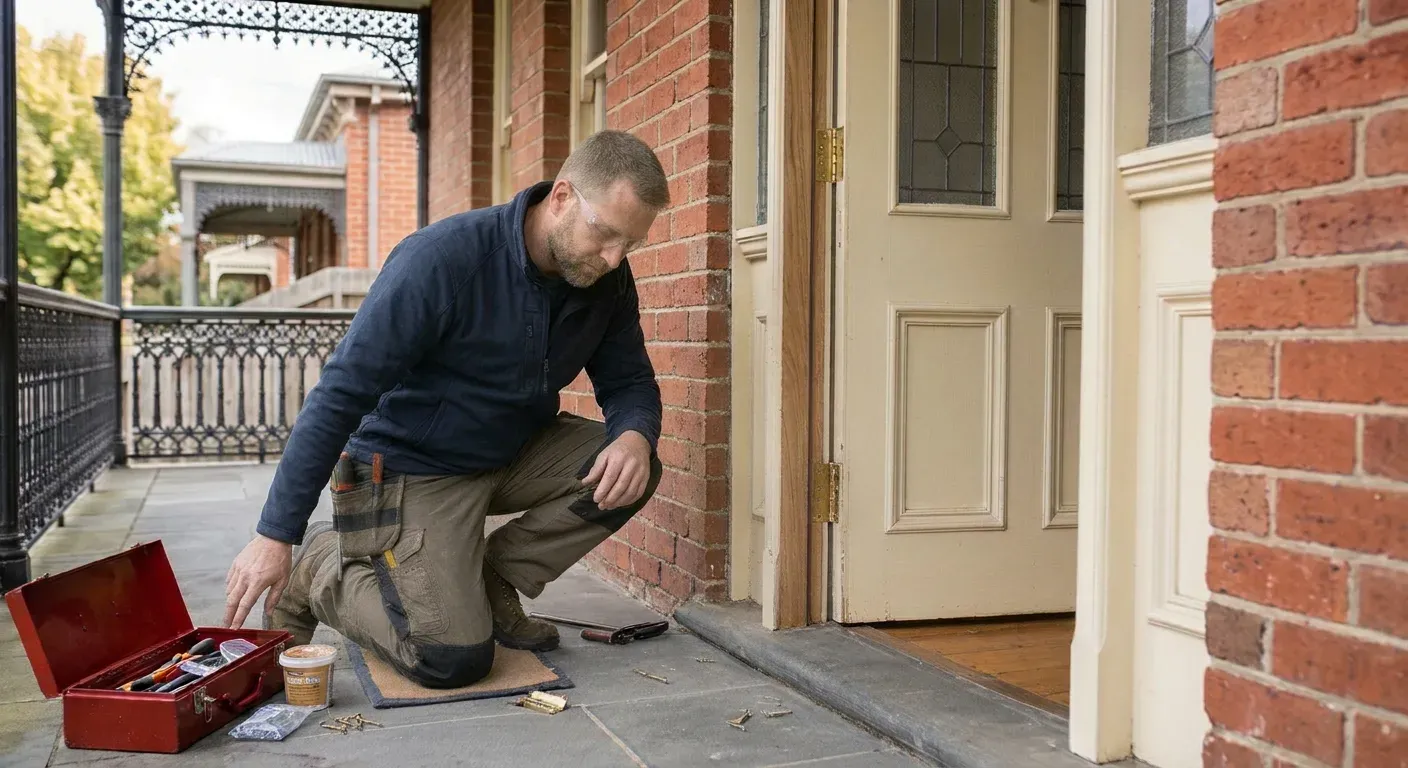
We help with sticking doors, doors that will not close or latch, loose hinges and handles, and damaged standard internal doors. If a door can be adjusted, we repair it. If the door is beyond repair and the frame is suitable, we replace it.
This page covers door repairs and standard internal door replacement, plus the related lock, fly screen and cabinet repairs below. Choose a topic to jump to it.
A symptom points us in the right direction, but the cause is confirmed once we have seen the door in photos or on site. Here is what each problem usually involves.
Door rubbing on carpet or flooring
New carpet or a floating floor can raise the floor under the door, or the door may have dropped on its hinges. The fix may be a hinge adjustment, or taking the door off and trimming the bottom edge.
Door not closing or latching
The latch often no longer lines up with the striker plate because the door or frame has moved. Re-aligning the striker or hinges usually comes before replacing the latch itself.
Loose or dropped hinges
Screws that have stripped their holes let a door sag towards the floor. Holes can be plugged and re-fixed, longer screws used where the frame allows, or worn hinges replaced.
Damaged internal door
Holes, split skins, peeling veneer or swelling from water. Small dents can sometimes be filled, but a punctured hollow-core door is often better replaced than patched.
Loose or broken handle
Handles loosen as screws back out or the latch mechanism wears. Tightening or replacing the handle set usually fixes it, as long as the new set suits the door’s thickness and existing holes.
Internal door replacement and installation
When a door is split, punctured or too warped to adjust, replacing it is usually simpler than repairing it. We replace standard hinged internal doors, such as bedroom, bathroom, laundry, hallway and linen doors, in existing frames.
Door leaf or frame: what is being replaced
The door leaf is the door itself. The frame, or jamb, is the timber lining the opening that the hinges and striker plate are fixed to. Most internal door replacements change only the leaf and keep the frame.
That works when the frame is solid, reasonably square and not split around the hinges or striker. If the frame is damaged, out of square or the opening size needs to change, the job becomes frame work and needs its own assessment. We do not alter wall framing or openings.
Matching your existing doors
The new door needs to match the height, width and thickness of the opening, and ideally the style of the other doors in the house, whether flush, panelled or moulded. Many Australian internal doors are 2040 mm high and 35 mm thick, in widths from about 620 mm to 870 mm. Older homes often have non-standard sizes, which can limit off-the-shelf choices or mean a larger door is trimmed down.
Reusing hinges, handles and latches
Hardware in good condition can often move across to the new door, which keeps it matching the rest of the house. The new door is recessed for hinges in the same positions as the frame and bored to suit the latch and handle. Worn hinges, a sticking latch or a handle that does not suit the new door are better replaced, and the quote will say which applies.
Why trimming, hardware and frame condition matter
A replacement door is rarely a straight swap. It is trimmed for even gaps around the edges and clearance above the floor covering, then hinge recesses and latch holes are cut to line up with the frame. Hollow-core doors have only a narrow solid rail around the edge, so there is a limit to how much can be trimmed before the door is weakened. An out-of-square frame means more trimming, and a damaged frame may need attention before a new door will close properly.
Hollow-core or solid-core?
Hollow-core
A light honeycomb core between two thin skins. Common in Australian homes, light on hinges and affordable, but easier to puncture, with less sound reduction and limited trimming.
Solid-core
A dense timber or particleboard core. Heavier, more resistant to knocks and usually better at reducing noise between rooms. The extra weight may call for heavier-duty hinges and a frame in good condition.
A solid-core door can reduce noise but will not soundproof a room, because gaps around and under the door still let sound through. Tell us what matters to you and we will discuss whether a solid-core door suits the opening.
Repair or replace?
A quick guide to which way a door job usually goes. We confirm the right approach from photos or on site.
Repair or replace guide for internal doors
What you are seeing
Usual direction
Why
The door sticks, rubs or will not latch, but the door itself is sound
Repair
Adjusting hinges, moving the striker plate or a light trim usually sorts alignment.
Hinges, handle or latch are worn, loose or broken
Repair
New hardware on a sound door is usually the simpler fix.
The door is split, punctured, swollen or badly warped
Replace the door
Damage to the skin or core of a hollow-core door rarely repairs neatly.
The frame is split, loose or out of square
Assess the frame first
A new door will not hang well in a damaged frame, so the frame is looked at separately.
What affects the price?
Two door jobs that sound alike can differ once the door and frame are seen, so we quote each job rather than publish set prices. These are the things that shape your quote.
Number of doors
Tell us the total so one quote covers every door, rather than one job at a time.
Door type and size
Hollow-core or solid-core, flush or panelled, and standard or non-standard dimensions.
Frame condition
A solid, square frame is straightforward. Splits, loose jambs or an out-of-square opening add work.
Trimming and fitting
How much the door needs trimming, and whether new hinge recesses and latch holes are cut.
Hardware and materials
Reusing your hinges, handle and latch, or fitting new ones.
Painting or finishing
Whether the new door is painted to match, and to what finish.
Removal and disposal
Whether the old door and packaging are taken away.
Pricing and what is included are agreed with you before anything is booked.
Other door, screen and cabinet repairs
Door work often comes with a few related jobs. Include small household repairs in the same request so the list can be quoted together. For a handover or tenanted property, see rental maintenance requests for work-order and access details.
Lock, latch and handle repairs
A key that is hard to turn or a latch that will not catch is often a door problem as much as a lock problem: the door has dropped, the striker plate has moved, or the mechanism needs freeing up. We check the door and its alignment first, then adjust, free up or replace the hardware.
Where a lock is worn out or broken, we can replace it with a standard handle set, lockset or deadlock that suits the existing door. Photos of both sides of the door and the edge plate help us confirm what will fit. This is repair work on standard hardware, not an emergency lockout or security service.
Front or back door lock that is stiff to turn
Latch or deadbolt that misses the striker plate
Loose or broken handle sets
Fly screens and screen door re-meshing
Torn or bagging insect mesh lets in flies and mosquitoes. We replace the mesh in existing window fly screens and hinged or sliding screen doors, tensioning new mesh into the frame with fresh spline.
Ordinary insect mesh is a fine, flexible mesh held in by a rubber spline. Security mesh, such as stainless steel or perforated metal, is part of a security door system and is a different product, so tell us which you have. If a frame is bent, its corners have split or a sliding screen no longer runs smoothly, mention it so we can say whether the frame is worth re-meshing.
Re-meshing torn window fly screens
Replacing pet-damaged mesh on a screen door
New spline where mesh has pulled out of the frame
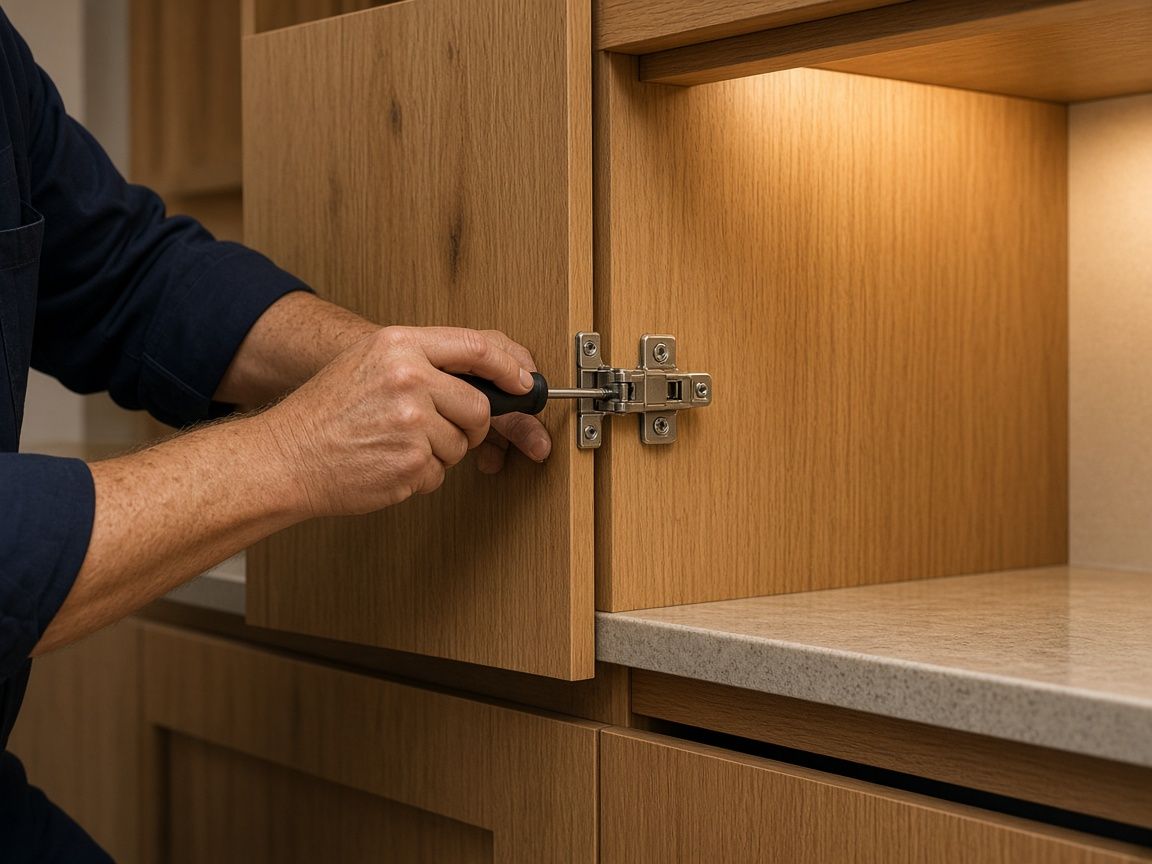
Cupboard and cabinet hinges, handles and alignment
Kitchen and vanity doors drift when hinges wear or soft-close fittings fail. We replace compatible hinges, fit new handles and adjust doors so they close cleanly and sit in line. Soft-close upgrades are quoted only where the existing cabinets can take them.
Cupboard doors that sit unevenly or will not close flush
Broken or loose concealed hinges
New handles or knobs on existing doors
How it works
Request a callback
Leave your name, mobile and suburb in the form and pick the closest job type.
Talk through the problem
We call to discuss the door and may ask for photos of the door, frame and hardware.
Review your quote
The quote sets out the work and what is included. There is no obligation to go ahead.
Agree on an appointment
If you are happy with the quote, we agree on a time that suits you.
Help us assess your job
The more we can see before the visit, the more accurate your quote. When we call, these details help:
Your suburb, and how many doors or other items need work
A photo of the whole door and frame, from each side if you can
Close-ups of the hinges, handle, latch and the door edge
Approximate height, width and thickness of the door, if you know them
Whether you have already bought a replacement door
About measurements. Approximate sizes are fine for a first conversation. The opening is checked before a door is ordered, trimmed or fitted.
Sending photos. We will ask for photos after we talk, or you can request a detailed quote, describe the job and mention you have photos, and we will follow up by SMS or email to collect them.
Where we do this
We are based in Fawkner and work in homes across Melbourne’s northern and north-western suburbs. If your suburb is not listed, enter it in the form and we will confirm whether we can help.
Yes, where the existing frame is solid and square enough to hang a new door. We fit a new door leaf in the existing opening, trim it to suit, and fit the hinges, latch and handle. Photos and approximate sizes help us quote, and the frame and fit are checked before a door is ordered or cut.
Can you fix a door rubbing on new carpet?
Usually. If new carpet or flooring has raised the floor, the door is taken off, trimmed at the bottom and re-hung. If the door has dropped on its hinges instead, adjusting or re-fixing the hinges may be enough. Hollow-core doors can only be trimmed so far, so tell us roughly how much the floor has risen.
Can the existing frame be reused?
In most standard replacements, yes. Only the door leaf is changed and the frame stays, provided it is solid, reasonably square and not split around the hinges or striker plate. If the frame is damaged or the opening needs to change, we will tell you whether we can repair it or whether it needs a carpenter or builder.
Can existing hinges and handles be reused?
Often, if they are in good condition and suit the new door. The new door is recessed to line up with the hinge positions on the frame and bored to suit the latch and handle. Hardware that is worn, sticking or does not suit the new door is better replaced, and your quote will say which applies.
Can I supply my own replacement door?
Let us know if you have already bought a door or plan to. Whether we fit a door you supply, and any supply arrangements, are confirmed in your quote. Check the size with us before buying, because a door that has been trimmed or drilled may not be returnable.
What photos and measurements should I provide?
A photo of the whole door with its frame from each side, plus close-ups of the hinges, handle, latch and the door edge. If you can, add the height, width and thickness of the door and mention any new flooring. Approximate sizes are fine for a first conversation; the opening is checked before anything is ordered or fitted.
Are materials, painting and disposal included?
Only where your quote says so. The door, hardware, painting and removal of the old door can each be included or left out, so the quote lists exactly what is covered before you book. Many new doors come raw or primed, so mention it if you want the door painted.
Can you fix a lock that is hard to turn?
Often, yes. A stiff lock is frequently caused by a door that has dropped or a striker plate that has moved, which we can adjust. If the lock itself is worn out or broken, we can replace it with a standard lockset that suits the door. This is a repair service, not an emergency lockout service.
Can you replace kitchen cupboard hinges?
Yes where the existing doors and carcass can take compatible hinges, including many soft-close fittings. Photos of the hinge cup and door edge help us confirm.
What do you need to quote fly screen or door mesh repairs?
The number of screens, rough sizes, and a photo of each one showing the damage and the frame corners. For screen doors, say whether they are hinged or sliding, and whether the mesh is standard insect mesh or a security mesh.
Do I need to take the fly screens out before you arrive?
No. Leave them in place and make sure the windows and screen doors can be reached from inside and outside. Clear sills and move anything stored in front of them.
Request a callback
Tell us about the door, lock, screen or cabinet and we will call you back to talk it through. Prefer to write out the details first? Request a detailed quote.